
Ontario High School Ratings:
What the Data Shows
We rated 762 Ontario secondary schools using 2024-25 EQAO data — the most recent available.
Two school boards. Thirty minutes apart on the 404. One has a median rating of 8.0 — more than half its high schools score above 8 out of 10. The other’s median is 5.8.
Same province, same curriculum, same government funding model. But if you’re buying a house and your kids are heading into high school, the board you land in changes everything.
We rated 762 Ontario secondary schools using 2024-25 EQAO data — the most recent available. Here’s what we found.
What’s Different About High School Testing
If you’ve read our elementary school ratings article, you know we rate elementary schools across Math, Reading, and Writing — six separate measures across Grades 3 and 6.
Secondary is a different beast. EQAO tests just two things:
1. Grade 9 Mathematics — Same achievement levels as elementary (Level 1 through 4). A student scoring Level 3 or higher is meeting the provincial standard. This is our richest data source: five achievement levels give us a detailed picture of how well students are performing.
2. The OSSLT (Ontario Secondary School Literacy Test) — Taken in Grade 10. Pass or fail. That’s it. No reading score, no writing score — just a binary: did the student demonstrate enough literacy to graduate?
The OSSLT has a nuance: two populations take the test each year. First-Time Eligible (FTE) students are Grade 10 students writing for the first time — about 84% of test-takers. Previously Eligible (PE) students are those retaking after a previous failure — about 16%. How a school handles its PE students says something real about its support systems.
This matters for how you read our ratings. When we say “Literacy Rating” for a secondary school, we’re measuring something fundamentally different from elementary. It’s not “how well do students read and write” — it’s “what percentage of students pass the graduation literacy test.” A more specific but narrower lens.
How We Rate (and How Fraser Differs)
Our approach is consistent with what we did for elementary, adapted for the test structure. Here’s how we compare to Fraser Institute’s 2025 Report Card on Secondary Schools:
| RealHunt | Fraser Institute | |
|---|---|---|
| Data year | 2024-25 | 2023-24 |
| Subject weights | Math 60%, OSSLT 40% | ~Equal by student count |
| Gender gap | Removed | 10% weight |
| FTE/PE weighting | Fixed 84/16 provincial | School-specific counts |
| Small school handling | Board-level Bayesian shrinkage | Not mentioned |
| Output | Overall + Math + Literacy | Single score |
Three things worth explaining:
Why 60% Math?
The OSSLT is pass/fail — one bit of information. Grade 9 Math has five achievement levels, giving us far more signal about where a school actually sits. Math also carries more discriminatory power (13% higher variance). We give it more weight because it tells us more.
Why fixed FTE/PE weights? If we weighted FTE and PE by each school’s actual proportions, schools with weak FTE results would get penalized twice. Weak FTE performance → more students fail → more PE students next year → school’s OSSLT score now weighted more toward the struggling group. Fixed 84/16 weights break that feedback loop.
Why remove gender gap? Same reasoning as elementary. In smaller schools, the gender performance split is statistical noise — it swings year to year based on which specific students are tested. It doesn’t answer: will my child learn effectively here?
The Results
We rated 762 Ontario secondary schools using this methodology. Here’s what the distribution looks like:
RealHunt school ratings distribution | RealHunt Analysis
The distribution is centered around 6.0, designed to be comparable year-over-year. But look at the tails: secondary has a wider spread than elementary. The standard deviation is 1.60 (vs 1.48 for elementary), meaning high school ratings swing more — more schools at the extremes, both high and low.
High-Performing Schools
About 17% of Ontario secondary schools scored 7.5 or higher. Only 1.3% (10 schools) reached the exceptional 9.5+ threshold:
| Rating | Schools | Percentage |
|---|---|---|
| 7.5+ | 129 | 16.9% |
| 8.0+ | 82 | 10.8% |
| 8.5+ | 42 | 5.5% |
| 9.0+ | 21 | 2.8% |
| 9.5+ | 10 | 1.3% |
High-performing schools by rating threshold | RealHunt Analysis
Top 10 Schools
The highest-rated Ontario secondary schools in 2024-25. One pattern jumps out: nearly every top school has a perfect or near-perfect Math score with Literacy trailing slightly behind:
| School | Overall | Math | Literacy |
|---|---|---|---|
| É.s. Norval-MorrisseauConseil scolaire Viamonde | 10.0 | 10.0 | — |
| Oakville Trafalgar HSHalton DSB | 9.7 | 9.9 | 9.5 |
| Cardinal Carter Academy for the ArtsToronto Catholic DSB | 9.7 | 10.0 | 9.2 |
| St Michael's Choir SToronto Catholic DSB | 9.7 | 10.0 | 9.4 |
| St Theresa of Lisieux CHSYork Catholic DSB | 9.7 | 10.0 | 9.2 |
| St AugustineYork Catholic DSB | 9.6 | 10.0 | 8.9 |
| Pierre Elliott Trudeau HSYork Region DSB | 9.6 | 10.0 | 9.1 |
| St Robert Catholic HSYork Catholic DSB | 9.5 | 10.0 | 8.9 |
| Ursula Franklin AcademyToronto DSB | 9.5 | 9.6 | 9.4 |
| Markville SSYork Region DSB | 9.5 | 10.0 | 8.7 |
Ursula Franklin Academy is the rare exception — 9.6 Math, 9.4 Literacy — balanced excellence in a field of math specialists.
The Math-Literacy Divide
This is where secondary diverges most from elementary.
Source: EQAO 2024-25 | RealHunt Analysis
Of the 737 schools with both Math and Literacy ratings, 38% are balanced (gap ≤ 0.5 points). But 8% are strongly math-dominant (Math > Literacy by 1.5+ points) and 10% are strongly literacy-dominant. The average gap between a school’s Math and Literacy scores is 0.96 — nearly a full rating point.
Pattern: strong math tends to pull overall ratings up; weak math tends to drag them down — more so than literacy.
School Profile Examples:
Unionville HS
Ursula Franklin Academy
Newtonbrook SS
The Board Rankings
Top 10 English-language boards by average secondary school rating | RealHunt Analysis
York Region DSB has a median of 8.0 — meaning more than half its 33 secondary schools score above 8. If you picked a York Region high school at random, there’s a 61% chance it scores 7.5 or higher.
Compare that to Toronto DSB: 73 schools, average 5.7, median 5.8. But Toronto is not a monolith — it still produces 14 schools above 8.0, more than any other board in absolute numbers. The range within Toronto (from 1.6 to 9.5) is enormous.
For the GTA boards that homebuyers compare most often: Peel DSB (36 schools, avg 6.0), Durham DSB (19 schools, avg 6.0). Both sit right at provincial average.
The Geography Gap
Average secondary school rating by Ontario region | RealHunt Analysis
Nearly two full rating points separate the GTA (6.4) from Northern Ontario (4.5). Eastern Ontario has zero schools scoring 7.5 or higher. Northern Ontario has just two.
This correlates with population density, socioeconomic factors, and school size. But it’s worth seeing the numbers plainly. Where you live in Ontario shapes the school quality available to your kids more than most families realize.
Where the Top Schools Are
84 secondary schools scored 7.5 or higher. The map makes the geographic clustering obvious:
84 secondary schools rated 7.5+ (2024-25). Hover for details. | RealHunt Analysis
The top-rated secondary schools cluster in a narrow geographic corridor — York Region (Markham, Richmond Hill, Aurora, Thornhill), Halton (Oakville, Burlington), and specific pockets of Toronto (Lawrence Park, North York, Etobicoke). A handful in Ottawa. Almost nothing outside these areas above 7.5. If secondary school quality is a factor in your home search, this map is the starting point.
See It in the App
In the RealHunt app, secondary school ratings work exactly like elementary — you see them on every listing, with the same three-score breakdown:
- Overall Rating — displayed prominently
- Math + Literacy breakdown — expand for details
- 4-year performance trend — see the trajectory
Every rating uses 2024-25 EQAO data, the most recent available. Fraser’s latest secondary report uses 2023-24 — a full school year behind.
The methodology is transparent: Math 60%, OSSLT 40%, no gender gap noise, board-level shrinkage for small schools. You know exactly what goes into the number.
Try RealHunt with the Latest School Ratings
Available on Android and iOS.
Or browse homes for sale by city on the web.
Appendix: Data & Methodology
Data Sources
- EQAO Grade 9 Mathematics Assessment — Achievement levels (0-4)
- OSSLT — Pass rates for FTE and PE populations
- Years Covered — 2021-22, 2022-23, 2023-24, 2024-25
- Schools Rated — 762 Ontario secondary schools
- Scope — Publicly funded Ontario secondary schools with reportable EQAO data; includes both English and French public school systems; excludes private/independent schools
Methodology
- Z-score standardization within language groups (English/French separately), mapped to 0-10 scale with median ~6.0
- Subject weights: Math 60%, OSSLT 40%
- OSSLT combines FTE (84%) and PE (16%) using fixed provincial weights
- Board-level Bayesian shrinkage (k=3) for small samples: Math/FTE when n<20, PE when n<50
- Schools need ≥12 students in Math or OSSLT FTE to receive a rating
Explore the full picture: search any Ontario secondary school or city, with complete rating histories, on School Atlas.
Read Next
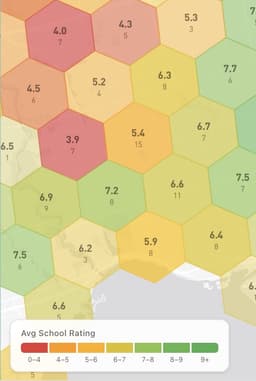
Introducing School Atlas:
A Map of Every Ontario School
A free map of every Ontario school we rate. Four-year trends, sortable city pages, and what a school rating actually tells you about a neighbourhood.
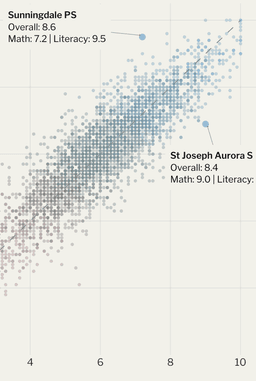
Why We Built Our Own
School Rating System
Existing ratings lag behind official data releases. We pull EQAO results directly to give you fresher, more detailed insights into Ontario elementary schools.
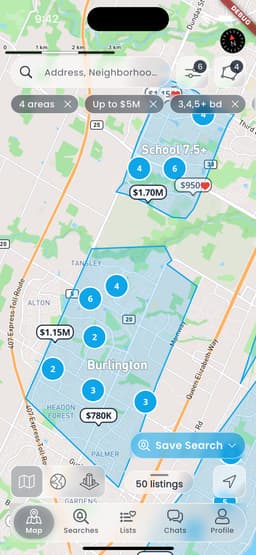
House Hunting Should Be Simple.
Most Apps Make It Complicated.
We built RealHunt to make home searching enjoyable and efficient — with native maps, smart alerts, transparent school ratings, and direct chat with the agent.