
Why We Built Our Own
School Rating System
Existing ratings lag behind official data releases.
We pull EQAO results directly to give you fresher, more
detailed insights into Ontario elementary schools.
You're scrolling through listings. Nice house. Good price. Then you check the school rating: 6.8/10.
Is that good? Good for what? And when was that number last updated?
That frustration led us to dig into the data ourselves. We built our own school rating system for Ontario elementary schools—and what we found explains why existing ratings often don't match what families actually see in schools.
The Problem with Existing Ratings
The Data Lags Behind
EQAO releases test results each fall (typically Oct–Dec). By the time those results make it to popular rating sites, months or even years have passed.
Fraser Institute released their January 2026 Report Card using 2023-24 EQAO data. EQAO released 2024-25 results on December 3, 2025—meaning Fraser's ratings reflect the prior school year, even though more recent data was already available.
Most real estate platforms rely on third-party rating providers whose data sources aren't publicly disclosed. Based on our research comparing published ratings to EQAO release timelines, many are using data that's several years outdated.
We pull EQAO data directly and update within weeks of release. Our current ratings use 2024-25 data—the most recent available.
Single Numbers Hide What Matters
A school with an 8.5 rating could be:
- Strong in Math (9.5) but weaker in Literacy (7.5)
- Balanced across subjects (8.5 in both)
- Strong in Literacy (9.5) but weaker in Math (7.5)
Those are three very different schools. A single number doesn't tell you which one matches your priorities—and for many families, that distinction matters.
The Formulas Undervalue Math
Many rating systems treat Reading and Writing as separate components while Math is single, effectively giving Literacy more weight. In their approach to achievement scores, this pattern appears across major rating systems.
We use Math 40%, Reading 30%, Writing 30%. Math gaps compound—a student behind in Grade 3 often struggles through high school, limiting STEM, finance, and data science careers. Early Math skills transfer to logical reasoning and systematic problem-solving. A 33/33/33 split underweights the subject where early gaps have the most compounding effects.
Why Math matters:
• Career readiness - STEM, finance, data science, engineering all require strong Math foundations
• Compound effects - Math skills build on each other; early gaps widen over time
• Critical thinking - Mathematical reasoning transfers to problem-solving across domains
Some Factors Add Noise, Not Signal
Fraser Institute dedicates 20% of their score to "gender gap"—penalizing schools where boys and girls perform differently.
We removed this entirely.
In smaller schools, gender performance differences fluctuate randomly year-to-year based on which students are tested. A 30-student school can see wild "gender gap" swings without any change in teaching quality. More importantly, it doesn't answer what parents actually care about: Will my child learn effectively here? Whether boys and girls scored equally tells you nothing about curriculum quality or your child's likely outcomes.
We focus on academic results: Math, Reading, Writing.
What We Did Differently
Fresh Data, Fast Updates
We query EQAO's public data directly. EQAO released 2024-25 results on December 3, 2025, and we had our ratings updated within weeks.
That means you're looking at current information, not last year's snapshot.
Three Ratings, Not One
Every school gets three scores:
- Overall Rating (0-10) — Weighted: 40% Math, 30% Reading, 30% Writing
- Math Rating (0-10) — Math performance only
- Literacy Rating (0-10) — Reading and Writing combined
This lets you see the school's profile at a glance. Is it Math-focused (strong STEM preparation)? Literacy-focused (strong humanities/arts foundation)? Or balanced across subjects? You can evaluate based on what matters most to your family.
Source: EQAO 2024-25 | RealHunt Analysis
Math and Literacy scores are usually correlated—most schools perform similarly in both. But some schools stand out: strong in one subject while still building the other. These profiles matter when choosing a school that matches your priorities.
School Profile Examples:
Corpus Christi Sep S
Claude Watson School for the Arts
St. Edward Catholic Elementary School
Four-Year History
We show ratings for 2021-22 through 2024-25 so you can see trends over time. Is the school improving, declining, or maintaining consistent performance? The trend matters as much as the current score—especially for schools recovering from pandemic disruptions or adapting to curriculum changes.
How We Handle Edge Cases
Small schools (<40 students): Year-to-year scores can swing wildly when sample sizes are tiny. We apply Bayesian shrinkage (fancy term for: we slightly pull them toward their school board's average) to reduce noise while preserving local context. This matters: a school with 15 students tested can show a 2-point swing just from which kids happened to be sick that day. Most schools (>97%) aren't affected by this adjustment.
Missing data: A school must have sufficient data (≥12 students) in key subjects to receive a rating. If a school doesn't meet that threshold in a given year, we don't force a rating. Better to show nothing than to show random noise that looks like a real score.
The Results
We rated 3,537 Ontario elementary schools using this methodology. Here's what the distribution looks like:
RealHunt school ratings distribution | RealHunt Analysis
High-Performing Schools
About 16% of Ontario elementary schools achieved a rating of 7.5 or higher in 2024-25, representing strong academic performance across all subjects. Only 0.4% (15 schools) reached the exceptional 9.5+ threshold:
| Rating | Schools | Percentage |
|---|---|---|
| 7.5+ | 556 | 15.7% |
| 8.0+ | 320 | 9.1% |
| 8.5+ | 159 | 4.5% |
| 9.0+ | 63 | 1.8% |
| 9.5+ | 15 | 0.4% |
High-performing schools by rating threshold | RealHunt Analysis
Top 10 Schools
The highest-rated Ontario elementary schools in 2024-25, showing exceptional performance across all subjects:
| School | Overall | Math | Literacy |
|---|---|---|---|
| Claude Watson School for the ArtsToronto DSB | 10.0 | 10.0 | 10.0 |
| St Davids Public SchoolDSB of Niagara | 10.0 | 10.0 | 10.0 |
| St. John XXIII Sep SRenfrew County Catholic DSB | 9.9 | 10.0 | 9.8 |
| St Justin MartyrYork Catholic DSB | 9.9 | 10.0 | 9.9 |
| Arbor Glen PSToronto DSB | 9.9 | 9.7 | 10.0 |
| Twenty Valley Public SchoolDSB of Niagara | 9.8 | 10.0 | 9.7 |
| St. Edward Catholic Elementary SchoolNiagara Catholic DSB | 9.8 | 9.6 | 10.0 |
| Hollywood PSToronto DSB | 9.7 | 10.0 | 9.5 |
| Zion Heights Middle SchoolToronto DSB | 9.6 | 10.0 | 9.3 |
| St. Isabel Catholic Elementary SchoolOttawa Catholic District School Board | 9.6 | 10.0 | 9.4 |
Post-COVID Math Recovery
One trend worth noting: Math scores took longer to recover than Literacy after pandemic disruptions. By 2024-25, Grade 3 Math reached 63.7% of students meeting provincial standards—up 5.6 percentage points from the 2021-22 low.
Source: EQAO 2021-25 | RealHunt Analysis
See It in the App
In the RealHunt app, you'll find school ratings that are transparent, current, and designed for how families actually evaluate schools.
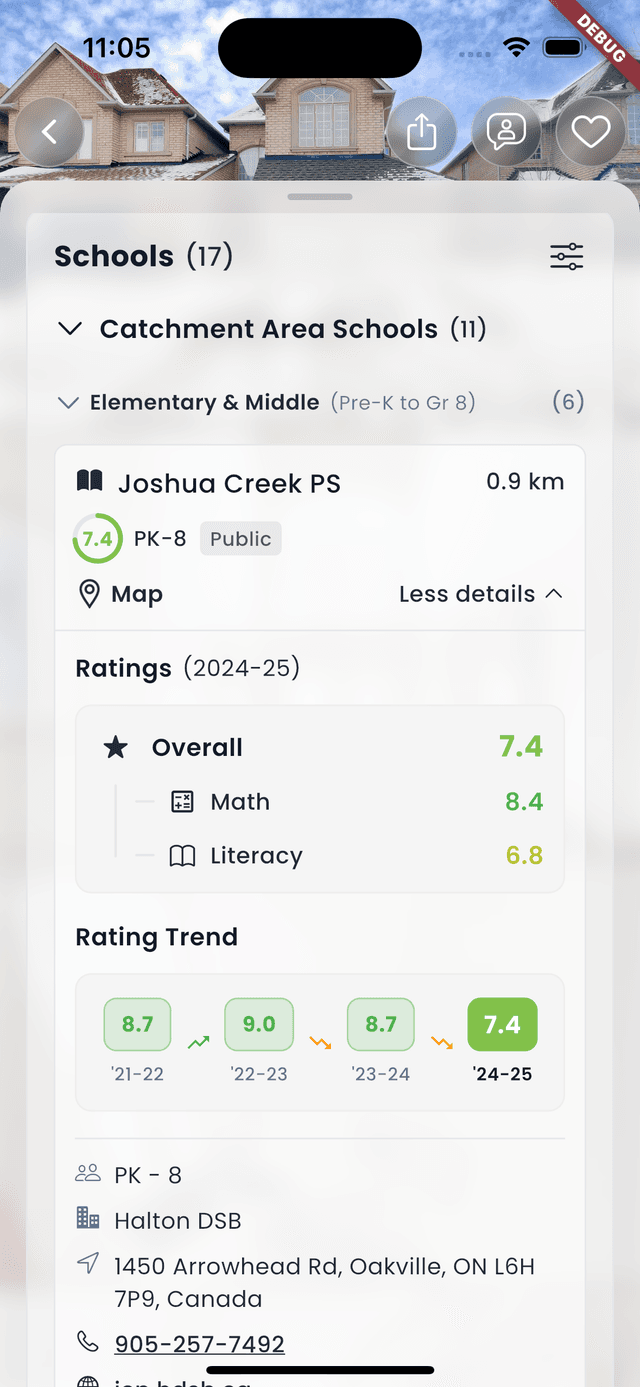
What makes our ratings better:
Up-to-date: Updated within weeks of EQAO data release—no year-old snapshots.
Transparent: You see exactly what's measured: Math, Reading, Writing. No hidden factors.
Detailed: Three separate scores (Overall, Math, Literacy) so you can evaluate based on your priorities.
Trend-aware: Four years of history show whether a school is improving, stable, or declining.
Each school card in the app shows:
- Overall Rating — displayed prominently
- Math + Literacy breakdown — expand for details
- 4-year performance trend — see the trajectory
Try RealHunt with the Latest School Ratings
Available on Android and iOS.
Or browse homes for sale by city on the web.
Appendix: Data Sources
- EQAO Elementary Assessments — Grades 3 and 6 (English and French programs)
- Years Covered — 2021-22, 2022-23, 2023-24, 2024-25
- Schools Rated — 3,537 Ontario elementary schools
- Scope: Publicly funded Ontario elementary schools (K–8) with reportable EQAO data; excludes schools without sufficient participation or missing core measures; includes both English and French public school systems; does not include independent/private schools
- Methodology — We compute Z-scores across Ontario schools each year, then map them to a 0-10 rating scale (clipped at boundaries) so that the distribution remains comparable year-over-year, with median approximately 6.0. Schools are rated relative to all other Ontario elementary schools. Subject weights: Math 40%, Reading 30%, Writing 30%. Small schools use Bayesian shrinkage toward school board averages to reduce noise. We base subject scores on EQAO achievement results (Grades 3 and 6 reading, writing, math).
Look up any school: every rated Ontario elementary school — from top performers like Oriole Park Jr PS and Rosedale Jr PS to your own neighbourhood — is searchable on School Atlas.
Read Next
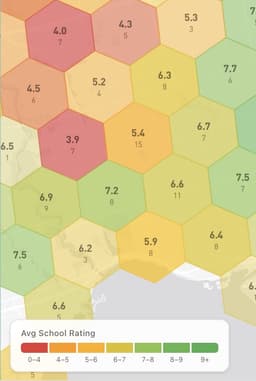
Introducing School Atlas:
A Map of Every Ontario School
A free map of every Ontario school we rate. Four-year trends, sortable city pages, and what a school rating actually tells you about a neighbourhood.

Ontario High School Ratings:
What the Data Shows
We rated 762 Ontario secondary schools using 2024-25 EQAO data. Fresh ratings with Math and Literacy breakdowns, board rankings, and geographic patterns.
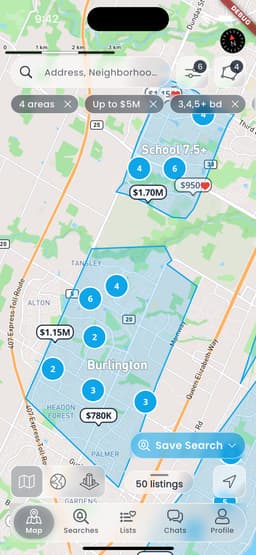
House Hunting Should Be Simple.
Most Apps Make It Complicated.
We built RealHunt to make home searching enjoyable and efficient — with native maps, smart alerts, transparent school ratings, and direct chat with the agent.